|
Is Governor Chris Christie, good political friend of Mitt Romney, delaying
a call for a transparent investigation for fraud and perjury charges surrounding New Jersey Supreme Court Official Robert
Correale and his powerful and influential former law firm, Maynard & Truland?
Please call Governor Chris Christie's
office at 609-292-6000 and state that John "Jack" Cunningham's allegations deserve a 'honest' New Jersey
State investigation. Please pass this request for calling Governor Chris Christie
to ALL your families and friends 'on and off' the internet. It's about time, New Jersey's state government
faced this Cover-up.
"A man good enough to shed
his blood for his country, is good enough to receive a square deal afterwards . .
." -- Theodore Roosevelt
"The willingness with which our young people are likely to serve in any
war, no matter how justified, shall be directly proportional to how they perceive veterans of early wars were treated and
appreciated by our nation."
- George Washington
GOD BLESS OUR VETERANS
Help give America's PTSD
vets a stronger voice. Please join our Facebook Cause. We are nearing 14,000 members. PTSD disabled vets should
be protected under the Federal Americans with Disability Act?
CAP 2-2-2 November 1970
webmaster, disabled Vietnam vet
Jack Cunningham, back row, 2nd from right
|
PLEASE PRESS THE ABOVE PlCTURE |
Please press the above link to read the story.
----- Original Message -----
How cute is this?
Wouldn't you love to know what her conversation is about?
| Please press the picture & story for a larger Copy |

|
| Please press the picture & story for a larger Copy |
At times, there were only four (4) Americans in
a village of 2,000 homes.
Jack is holding his M-79 grenade launcher.
The weapon was nicknamed "The Blooper" because of the sound the weapon made, when it released a round.
Behind him is
the Song Thu Bon (River), just north of the Fifth Marines Combat Base at An Hoa.
WHY DO
THESE TWO YOUNG MARINES LOOK DRUNK?
Jack (Sussex, NJ) and George Dros (Cooperstown, NY) are sitting at a table in a Duc Duc
Refugee Village peasant hut, near the village's market place. The two, young United States Marines are members
of CAP Team 2-9-2. (CAP Teams were composed of about 8 to 13 Americans, who lived and served 24/7 in Vietnamese peasant-farming
villages. The Duc Duc Refugee Village was composed of about 2,000 homes.)
In the above picture, Jack's and George's eyes were shut,
because of complete exhaustion. It was July 1970. At the time this picture was taken, the Americans in Duc Duc
were not sure whether the CAP Unit would be pulled out of the village or whether it would be wiped out. We were experiencing
heavy combat. Intelligence reports were coming in daily that the Communists wanted to punish the village while the Americans
were still there.
By wiping out
CAP 2-9-2, the terrorists hoped to leave an example to other CAP Villages. With alerts at the highest level, night ambush
responsibilities were 100% watch throughout the night. With two long patrols a day going outside the village, it didn't
leave much time for the eight or so Americans to sleep.
Around the day this
picture was taken, an intelligence report came in from the 1st Marine Division Headquarters in Da Nang that the high Communist
Command wanted to speed up President Nixon's troop pullout from Vietnam. They wanted to embarrass the Americans on a
wide-scale and influence the American People into pressuring a faster troop pullout. Their plan called for wiping out
the Fifth Marines at An Hoa. It was going to involve thousands of Communist Forces. The Village of Duc Duc was
on the large Marine Base's perimeter and was said to be the main route for the Communist attack. Our orders that night
in July 1970 was to set up in the most well protected position. Our Cap Unit was expected to try and hold off the Communist
drive off as long as possible. We were expected to serve as a warning or trip wire (Queens Gambit) for the Fifth Marines.
Months after Jack and George pulled out of the
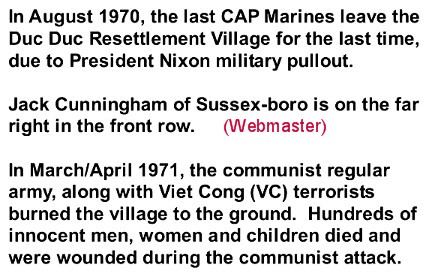
village of Duc Duc, the Vietnamese communists punished the peasant village by burning it to the ground. Hundreds of
civilian men, women and children were killed, wounded and reported missing. Two thousands homes were reduced to ashes.
The blaze could be seen from twenty-five (25) miles away in Da Nang. It was the light of the blaze that guided United
States Marines helicopters to the scene.
| CAP
Badge |
|
Parris Island, Marine Corps Boot Camp 1969
18 Years of Age
|
Jack Cunningham and his
wife, Joan |
 |
| PRESS PICTURE FOR LARGER COPY |

|
|
Above is nineteen year old Jack Cunningham with one of the boys
from the Duc Duc Refugee Village.
Below is the full picture of the same scene.
| PRESS
PICTURE FOR LARGER COPY |

|
|
The boy with Jack is the Marine's village boy. These village boys would run errands, cook C-Rations,
clean up-after, massage tense muscles and serve as interpreters for the Marines. Usually, each Marine had their own
boy to help him around the village.
Many times, adult peasants of Duc Duc would supply these boys with intelligence information of planned
terrorist attacks on the village. Supplying these intelligence reports on terrorist movements and plans may have
been the reason why the Duc Duc Refugee Village was later burned to ashes.
A month after the above picture was taken, the boy lost both of his parents in a terrorist rocket attack
on their area of the Duc Duc Refugee Village. After his parents were killed, the boy moved to a relative's
home closer to the City of Da Nang; which in the long run saved his life the night of the Duc Duc Massacre. |
JULY 17, 1970
On what was going to turn out to be my hottest day in
Vietnam, we had asked our (new to the village) sergeant
for just a short, daily patrol. Although it was still morning, we had
already completed a number of our daily assignments around the village and the temperature was already scorching. As usual, our Navy Corpsman already had treated a long line of peasants and
my buddy, George Dros and I (our unit’s demolitionmen) had already setoff a couple of controlled explosions of dud high
explosive rounds that the local children collected. The loyal
children received payments based on the size of their dud round.
The CAP 2-9-2 patrol of five Marines and six Vietnamese Popular Forces (PFs)
Militiamen left Phu Da with full gear. Sergeant Donald Eifford led the
patrol down a small, dusty path between two tall cornfields. I was the
M-79 Grenadier and a Lance Corporal. When we exited the cornfields, Sergeant
Eifford took out his field glasses and spotted three figures entering a known Viet Cong frequented treeline. The treeline was once the site of a peasant village.
Since no villagers were allowed that far from Phu Da, it was safe to believe that the three figures entering the treeline
were Communists. Sergeant Eifford radioed for mortars on the jungle treeline
from the Fifth Marines Headquarters at An Hoa. (Only a month before, CAP
2-9-2,
two tanks and a company of about 130 Marine Grunts from the Fifth Marines worked the same area. Even with all those Marines and supporting equipment, the treeline was a bad neighborhood to say the least.)
Using Eifford’s map grid coordinates, the Marine mortars from An Hoa were very accurate. (He was excellent at calling in support for us.) Our
sergeant decided for the eleven-man patrol to go after the Communists.
About a mile into the thin, open rice patty dikes, fear triggered five of our six Village Militiamen to refuse to go
any farther toward the mile long piece of jungle. Even though we tried
to influence their decision, the militiamen refused. They were terrified. To be honest, having experienced combat there myself, I was a little worried. Without the other PFs, there would be only six of us in the thick treeline.
Like I already mentioned, the last time we dealt with the Communists in the same piece of jungle, we had about 130
men and 2 tanks. In spite of all the men and equipment, we still had to
call in F-4 Phantom fighter jets for a couple of bombing runs.
The
lone Vietnamese militiaman, who agreed to go along with us, was walking point (first) anyway.
He had to pass through five Marines on the less than two-foot wide rice patty dike in order to leave with his buddies.
As the CAP 2-9-2 patrol came close to the treeline that only minutes earlier three Communists entered,
the sergeant ordered me to walk point (first) and slam the face of the treeline with M-79 Grenade Rounds. Immediately, I moved up in line and started firing. About
a hundred yards outside the large treeline, we had to stop. My grenade launcher
jammed from a BeeHive (shotgun-like) round casing. I cleared my weapon
and reloaded with just high explosive rounds.
(In the Command Chronology for CAP 2-9-2 for July 17, 1970, it was documented
that I shot a total of 22 M-79 High Explosive (HE) rounds that entire day. Although I picked my targets well, I thought that I shot much more than 22 high
explosive rounds. It was a long day under the hot sun.)
Once we entered the jungle, we immediately spread
out into two-man teams and found Communist huts, bunkers, and trenches and stored food supplies. My buddy
L/Cpl. George Dros did some extra searching under some heavy jungle canopy.
Inside a large hut that George found was Communist military documents and the equipment for making booby traps. In another hut, we found freshly cooked rice still warm in four bowls.
We were elated that we chased off the Communists.
I took my handy Kodak Instamatic Camera from my field jacket and started taking pictures. A couple of the guys even posed.
This feeling of satisfaction lasted only a few minutes. Suddenly,
we were hit from what seemed like every direction. The Communist
fire was extremely intense.
Immediately, Sergeant Eifford radioed for mortars
from the An Hoa Fifth Marine Base. The Willie Peter placing round was right
on target. However, probably because of the shifting of the M-81 mortar’s
tri-pod, the ten M-81 high explosive rounds walked directly towards where we were pinned down.
We thought that our own mortars would kill us. I didn’t know
what to do. The thought of moving to my right or left was out of the question. The Communist fire was too furious. The
last round exploded only about 20 yards in front of us.
After calling in the mortars, our sergeant called
in helicopter and fixed-wing air strikes. During one of the initial
passes over the trees, the fixed-wing pilot spotted a cluster of huts deep in the treeline.
He concentrated his ordinance and succeeded in triggering some secondary explosions.
During all the action, the rest of the Marines from CAP 2-9-2 and a few Vietnamese PF militiamen arrived
from Phu Da. Meanwhile, CAP 2-9-1 from the other side of the
An Hoa Marine Base rushed to our aid, but they got pinned down just outside the treeline that the six of us were surrounded
in.
For
a number of hours, we had to fight off the Communists ourselves. It
was in July and the temperature was said to be over 100 degrees. (I
don’t remember for sure, but the number 110 comes up. Our Navy Corpsman
had his mother send a thermometer just about a week before. (He was always
saying how hot it was. It became a joke for us.) Regardless, whether it was 100 or 110 degrees, it was extremely hot. Water ran
out early.
Once CAP 2-9-1 arrived, the Communists broke contact with us.
As the CAP’s demolitionmen, George Dros and I blew as much as we could with our C4 plastic explosives. After we ran out of C4, George and I collected some hand grenades and destroyed the remaining Communist
belongings and equipment.
It was very important what route we left the jungle. We needed to take a route that the enemy would not
expect us to take. Otherwise, the Communists would be setting up an ambush
for us. We set up security then left the treeline together on a route that
crossed through a chest high, slow moving stream. (My camera’s film
was destroyed.) While in the stream, a few guys were a little nervous about the
poisonous snakes, especially the deadly Bamboo Viper.
Once on the other side of the stream, CAP 2-9-1 left for their own village. The Americans and the few PF Militiamen of CAP 2-9-2 rested on a small knoll for a couple of minutes. We were out there under some ugly conditions for many hours and we needed
a much-needed rest. Besides, our water ran out hours before and a few of
us were near Heat Exhaustion. Myself included.
Our Navy Corpsman was tired of telling
us not to drink the filthy rice patty water. Since the patties were the
universal toilets for their peasant caretakers as well as water buffaloes and the watery grave of many insects, the Corpsman
didn’t appreciate us drinking the filth through our closed teeth and then wiping our teeth clean. (We didn’t bring our toothbrushes.) Our
sweat-soaked, camouflaged utilities were our tooth implement of necessity.
Three of my buddies went to search for
some desperately needed clean water.
(The problem was the three Marines went without their weapons. I’d
say the intense heat; the day’s activities and lack of water were getting
to them.)
After only a few minutes of rest, our sergeant jumped up. He was
in a hurry to get back to Phu Da for fear that the Communists might attack the unprotected village. (One of the Vietnamese Militiamen might have read one of the Communist documents that George Dros
found in the makeshift booby trap factory.)
I told the sergeant that the three men went for water without their weapons.
I volunteered to stay. All I cared about was that my friends
were out there with no weapons.
The Communists must have followed us. About fifteen minutes later,
as my three, joyful, wet-buddies were returning with the much needed water, the Communists attacked with rifle fire and small
explosive weapons. For protection, each of my buddies drove into a large,
rice patty filled with water. It was about a hundred yards wide and it separated
us.
For the next fifteen to twenty minutes, I fought alone in the open to draw the Communists' fire, so that my buddies would survive or not be captured. The sounds
of the zinging bullets and bombs were constant.
Thank God, those Viet Cong Terrorists
were bad shots.
In order to give the impression that there were more Marines on the knoll than just me, I switched between my M-79
Grenade Launcher to my buddies' M-16 Rifles and a
M-60 Machinegun. However,
I'm sure it didn't take long before the Viet Cong Terrorists realized I was the only American on the small knoll in the middle
of the open rice patties. If they killed me, the V.C. Terrorists could
just walk up to my buddies and do what they wanted to them.
(The Communist fire was pretty fierce.)
I was no different than any other American in the Combined Action Program.
The thought of leaving my Cap Brothers did not even enter my mind. At
the time, we only had about eight Americans living in Phu Da. I loved
them. One of my buddies pinned down before me in the rice patty was
even married and had children. Some
of George Dros' comments are below.
You could say that back then; I felt my buddies were all I had. Due
to a number of different circumstances, we felt very alone. Even, many
American people back home were against us fighting the Communists. In June 1970,
during a military sweep just outside our village, we found thousands of American Dollars that were donated to the Communist
Terrorists by an American College student
group at Berkeley University. The donated money may have been used for the bounties on our heads.
I served in Phu Da during the student
shootings at Kent State University.
I was also in Phu Da when my hometown of Rosedale, Queens had its Vietnam Veteran Memorial attacked twice by tar
and paint during 1970. (It's the first Vietnam Veteran Memorial
in all of America.)
http://home.earthlink.net/~rosedalememorial
Back at the knoll, a couple of the Marines who left with my sergeant returned to help but it took them some time walking
along the thin rice patty dikes. For all they knew, they were walking into
an ambush themselves. Our sergeant led the rest of the CAP 2-9-2
Americans and Vietnamese PFs back to protect Phu Da from a possible
Communist attack.
Daniel Gallerger was the first Marine to arrive to help me. He came
into the firefight shooting his weapon and laid down right next to me. Daniel’s
on The Wall in
Washington DC
for something that happened months later. He was a good Marine.
In the end, everyone was saved and my sergeant received a well-deserved medal for his actions. It was a miracle that no Americans were hurt that entire day.
On July 22, 1970, CAP 2-9-2
returned to the jungle treeline with three infantry companies (C, E, and F) of the Fifth Marines, tanks
and CAP 2-9-1.
My buddy George Dros (one of the guys
I saved) wrote his parents about the episode and they wrote and thanked my parents.
I felt great.
To this day, George and I
are extremely close and we both live up here in the beautiful, hilly farmland of Sussex County, New Jersey. However,
we don't really talk much about the war portion of serving in Phu Da, Vietnam. To this day, it's still extremely hard to talk about the ugliness of war.
Instead, we talk a lot about our American Buddies as well as our Vietnamese Friends and the many Vietnamese Parents
and Vietnamese Grandparents who adopted us into their families.
ACTUAL UNIT REPORT FOR JULY 17,
1970
|
17 July 70 |
A PF member of a CAP
2-9-2 patrol accidentally detonated an unknown type booby trap rigged with an unknown type firing device alerting an enemy
ambush at AT 872500, 2.5 km N of Duc Duc District Headquarters. The patrol received SAF and returned fire with organic weapons
fire, 22 M-79 HE rds, |
| |
2 M-72 LAAW
rds, and called a helicopter gunship fire mission on the
enemy. The enemy fled in an unknown direction. One PF was WIA by
the exploding SFD. The PF was rendered first aid and medevaced by
helicopter. A sweep of the area was nonproductive. RESULTS: 1 PF
WIA(E).
George Dros' Comments about the above action. |
Some time in July 1970, we went
on a (daily) patrol that took us farther into enemy territory than ever before. The temperature this day was in excess of
100 º. With only three (3) other Marines and 1 Chou Hoi, we confiscated a large
cache of Vietnamese communist terrorists (V.C) explosives, detonators, documents and battle plans for upcoming engagements. (This most probably was a small terrorist bobby-trap factory.)
After neutralizing their base
camp, we were hit by Viet Cong terrorists’ rocket-propelled grenades, mortars and small arms fire, pinning us down for
over an hour. We called for artillery from the Marine Cops’ 5th
Marines Combat base at An Hoa and a react team from our brother CAP team 2-9-1.
Return artillery fire was immediate.
It took CAP 2-9-1 a while to reach us, because as they neared the tree line that we were pinned down in, they were
also fired upon.
After about three hours, the
V.C. broke contact and both CAP teams started back to their respective villages. We had to cross a chest deep river, carrying
our weapons over our heads, but at least we were in our own back yard. We stopped on a small knoll for much needed water,
since we had run out of water hours before, because of the intense heat and sun. Two
Marines and I filled everyone’s canteens while Jack and the rest of the patrol stood cover.
Returning from the well, I saw
Jack standing cover by himself, as Sgt. Eiford thought the village might be hit and took the rest of the unit back with him
in case of enemy contact. As we made our way to the knoll that Jack was on, we
took heavy fire from our right, pinning us down behind a small rice paddy dike. Jack
then exposed himself to enemy fire to try and keep the V.C. away from us, switching from his own M79 grenade launcher, to
my M-16 rifle and one of the Marines’ M-60 machine gun. Jack kept the V.C.
off balance long enough for us to pull ourselves along by the rice stalks until reaching him.
The V.C. broke contact, probably fearing an artillery attack.
This was Jack, always caring
and making sure the people he loved were safe and protected from harm. Jack’s code in life has always been the same:
passion for his family, his country and the Corps. I will always be thankful for being a part of Jack’s family.
What is Jack Cunningham doing today instead of battling
terrorists in the Duc Duc Refugee Village?
Jack is battling the State of New Jersey for his Due Process
in his right to charge Legal Malpratice against a corrupt New Jersey Attorney Ethics Vice-Chairman Robert Correale.
It's been a six year battle so far for Jack, but he has some corrupt New Jersey politicians and officials ducking for cover.
Obstructing Ethics Investigations
US Senator Robert Menendez
closes his eyes to State Corruption, and then becomes part of the Corruption
Cover-Up...
Debbie Curto (Phone: 973-645-3192), a high level assistant to U.S. Senator Robert Menendez admits
that Jack Cunningham's evidence is understandable and clear that a group of attorneys committed perjury in official documents
to the State of New Jersey's Supreme Court. However, Senator Robert Menendez still refuses to support this disabled,
Vietnam Veteran obtain his Due Process from the State of New Jersey against a State Official for Legal Malpractice.
Instead of becoming a part of the solution to New Jersey State Corruption, Senator Robert Menendez becomes part of the Corruption
Cover-Up.
Read the understandable and
clear evidence for yourself at: http://www.americans-working-together.com/attorney_ethics/id50.html
A Recovering American Soldier
c/o Walter Reed Army Medical Center
6900 Georgia Ave NW
Washington, D.C. 20307-5001
Supporting our military and veterans is not about politics.
It's about respect, honor and appreciation.
The USO is a great organization.
Jack
.
Regarding the last paragraph,
I feel a short comment on who Jack Cunningham is and why I am here today at 55 instead of dead at 19.
Some time in July 1970, we went
on a (daily) patrol that took us farther into enemy territory than ever before. The temperature this day was in excess of
100 º. With only three (3) Marines and 1 Chou Hoi, we confiscated a large cache
of Vietnamese communist terrorists (V.C) explosives, detonators, documents and battle plans for upcoming engagements. (This most probably was a small terrorist bobby-trap factory.)
After neutralizing their base
camp, we were hit by Viet Cong terrorists’ rocket-propelled grenades, mortars and small arms fire, pinning us down for
over an hour. We called for artillery from the Marine Cops’ 5th
Marines Combat base at An Hoa and a react team from our brother CAP team 2-9-1. Return artillery fire was immediate.
It took CAP 2-9-1 a while to reach us, because as they neared the tree line that we were pinned down in, they were
also fired upon.
After about three hours, the
V.C. broke contact and both CAP teams started back to their respective villages. We had to cross a chest deep river, carrying
our weapons over our heads, but at least we were in our own back yard. We stopped on a small knoll for much needed water,
since we had run out of water hours before, because of the intense heat and sun. Two
Marines and I filled everyone’s canteens while Jack and the rest of the patrol stood cover.
Returning from the well, I saw
Jack standing cover by himself, as Sgt. Eiford thought the village might be hit and took the rest of the unit back with him
in case of enemy contact. As we made our way to the knoll that Jack was on, we
took heavy fire from our right, pinning us down behind a small rice paddy dike. Jack
then exposed himself to enemy fire to try and keep the V.C. away from us, switching from his own M79 grenade launcher, to
my M-16 rifle and one of the Marines’ M-60 machine gun. Jack kept the V.C.
off balance long enough for us to pull ourselves along by the rice stalks until reaching him.
The V.C. broke contact, probably fearing an artillery attack.
This was Jack, always caring
and making sure the people he loved were safe and protected from harm. Jack’s code in life has always been the same:
passion for his family, his country and the Corps. I will always be thankful for being a part of Jack’s family.
The below article comes from:
EMPIRE BLUE CROSS BLUE SHIELD
MANHATTAN, NY
Corporation News Letter
March / April 1986

John Huston was the film director who wrote to me in February
1986.
John Huston has the unique distinction of directing both his
father Walter and his daughter Anjelica in Oscar-winning performances (in The Treasure of the Sierra Madre and Prizzi's Honor, respectively), making the Hustons the first family to have three generations of Academy Award winners.
At the time, he wrote his letter to me, Mr. Huston was up for BEST DIRECTOR at the Academy
Awards that year:
|